

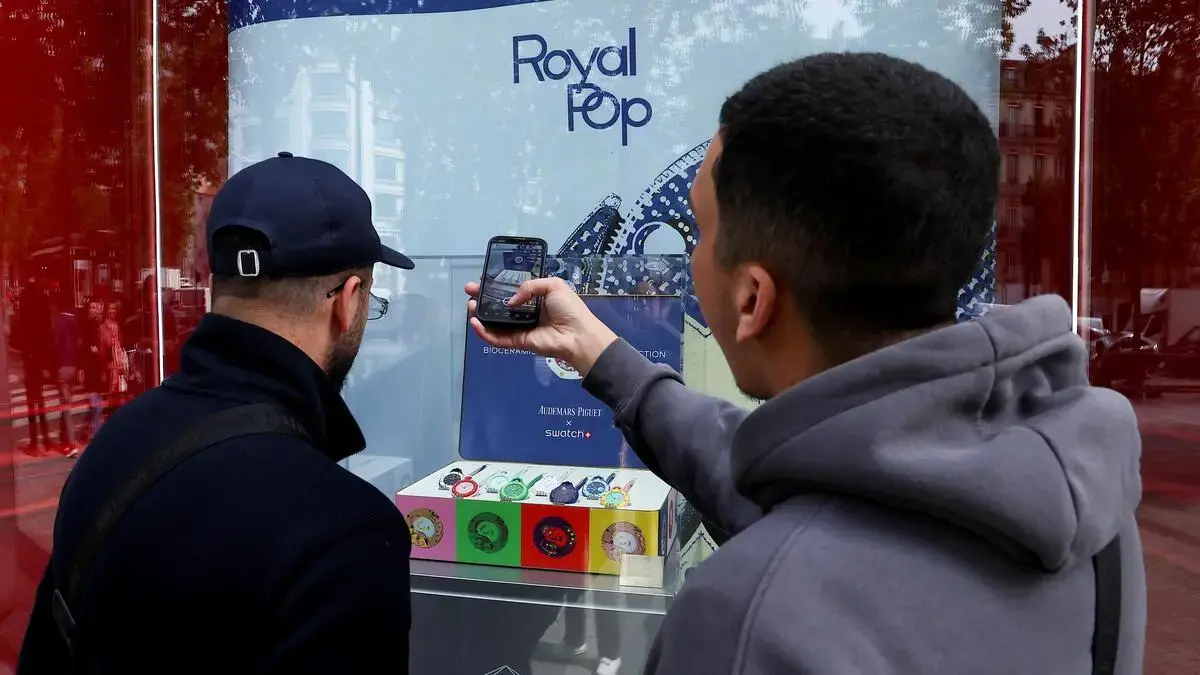
The recent collaboration between Swatch and Audemars Piguet, dubbed the "Royal Pop" collection, created a frenzy reminiscent of the Omega Moonwatch hype in 2022. Long lines formed outside Swatch stores, resale prices skyrocketed to five times retail, and social media exploded with unboxing videos. Yet, almost immediately after launch, Swatch’s stock price slipped. This paradox raises a critical question for investors: do these high-profile collaborations actually deliver long-term value to shareholders, or are they merely short-term marketing stunts that mask deeper corporate struggles?
Swatch Group, the Swiss giant behind brands like Omega, Longines, and Tissot, has been under intense pressure. An activist investor from GreenWood recently criticized the company for losing relevance. A Morgan Stanley report alleged market share losses, which Swatch denies. The company’s financials tell a stark story: net profit plummeted from 219 million Swiss francs in 2024 to just 25 million in 2025, hurt by a strong Swiss franc and rising production costs. The stock has fallen by roughly a third since the Moonwatch collaboration, while competitors like Seiko and Citizen have seen gains of over 250% and 256% respectively over five years. Even Richemont, owner of Cartier and Montblanc, posted an 80% increase. Swatch, in contrast, dropped 20% over the same period.
The Royal Pop collaboration undoubtedly created buzz, but it also exposed operational flaws. Stores had to close temporarily due to safety concerns, and many customers complained about limited availability and chaotic sales processes. Analysts noted that the hype did not translate into sustained investor confidence. The collaboration may have temporarily boosted brand visibility, but it did not address Swatch’s fundamental issues: currency headwinds, rising costs, and an over-reliance on a handful of core models. The Moonwatch collaboration, while initially successful, ultimately failed to reverse the stock’s downward trajectory. History suggests that one-off hype events rarely compensate for weak earnings trends.
Lessons from H&M: The Limits of Designer Partnerships
Swedish fashion retailer H&M pioneered the concept of high-low collaborations in 2004 with Karl Lagerfeld. Since then, H&M has partnered with a who’s who of luxury designers: Versace, Moschino, Balmain, Comme des Garçons, and even Lanvin. Each launch causes near-riots in stores and immediate sell-outs, often followed by a flurry on resale platforms. Yet, despite nearly two decades of such buzz, H&M’s stock has struggled. It is down roughly 11% year-to-date and 29% over five years, currently trading around 165 Swedish kronor. Barclays recently cut its price target to 150 kronor, citing persistent weakness in consumer demand and severe competition from ultra-fast fashion players like Shein, Temu, and Primark.
Under new CEO Daniel Ervér, H&M has focused on profitability improvements, but the underlying challenges remain. The collaborations generate enormous media coverage but do little to change the structural disadvantages H&M faces. Shein and Temu, with their data-driven supply chains and rock-bottom prices, have eroded H&M’s value segment. Meanwhile, Zara’s parent Inditex has outperformed significantly, delivering a 67% stock gain over five years. Inditex also does collaborations—for example, with designers like Stefano Pilati or brands like Bathing Ape—but its business model relies on speed and vertical integration, not limited-edition spectacles. Analysts remain cautious on H&M: only five of 31 covering the stock recommend buying, while 12 say sell.
The lesson is clear: flashy collaborations cannot mask a weak business model. H&M’s partnerships may create temporary revenue spikes and social media impressions, but they do not build lasting competitive advantages. Once the limited stock is gone, customers return to Shein or Zara, and the stock resumes its slide.
Adidas: When Collaborations Backfire
Sportswear giant Adidas has a long history of strategic collaborations, from years-long ties with Yohji Yamamoto (Y-3) and Stella McCartney to spicy partnerships with Gucci, Prada, and most famously, Kanye West’s Yeezy brand. The Yeezy line generated over $1.5 billion in sales in 2022 alone, making it one of the most successful collaborations in history. However, that success came with a massive risk: the brand became dangerously dependent on an individual. When Kanye West’s antisemitic comments forced Adidas to cut ties in late 2022, the company was left with a $500 million inventory pile-up and a gaping hole in its revenue. The stock, which had already been under pressure, dropped sharply and has never fully recovered. Over five years, Adidas shares have lost roughly half their value, and 2025 started with an 8% decline.
Beyond the Yeezy fallout, Adidas faces a challenging retail environment, rising competition from Nike, New Balance, and a resurgent Puma, as well as currency fluctuations. The company’s latest collaboration with Puerto Rican artist Bad Bunny has generated positive press, but analysts remain cautious on the stock’s valuation. Twenty-six analysts recommend buying, but that is partly due to the upcoming football World Cup boosting sports apparel sales. Even with short-term catalysts, the long-term record suggests that collaborations do not shield Adidas from its structural issues: slow innovation in performance footwear, supply chain complexity, and a strong dependency on lifestyle segments.
Interestingly, Adidas’s cooperation with Gucci and Prada used a different model—co-branded premium products—but those too had limited impact on the overall financials. The Yeezy experience shows that when a collaboration becomes too big, it can actually destabilize the company if the partner becomes toxic. Risk management, not buzz generation, is the real lesson.
Why Collaborations Fail to Lift Stocks
Across three industries—watches, fashion, sportswear—the pattern is consistent: limited-edition collaborations create short-term media noise and retail queues but rarely drive sustained stock outperformance. There are several structural reasons. First, collaborations target a niche audience of collectors and hypebeasts, not the broader customer base that drives recurring revenue. Second, the manufacturing and supply constraints that make collaborations exclusive also cap their revenue contribution. A one-off collection of a few thousand units, even at high margins, is a rounding error in a multi-billion-dollar company’s annual sales. Third, the operational complexity of managing store chaos, website crashes, and customer complaints often erodes any goodwill generated. Fourth, investors are increasingly sophisticated—they recognize that collaborations are marketing expenses, not strategic transformations.
Compare this with true business transformations. Inditex’s investment in RFID inventory tracking and centralized supply chains delivered years of margin expansion and stock growth without any need for celebrity tie-ups. Similarly, Richemont’s focus on hard luxury and digitalization paid off. Swatch, H&M, and Adidas, by contrast, have relied on hype to distract from fundamental issues: currency exposure, lack of differentiation, or supply chain inefficiencies. Until those issues are addressed, no amount of Royal Pop, Beyoncé collaboration, or designer capsule will sustainably lift the stock.
The 2022 Omega x Swatch Moonwatch is a perfect case study. It was a massive global phenomenon, with stores besieged and secondary prices soaring. Yet, two years later, Swatch’s stock was down 35% from the announcement date. The company’s profit warning in early 2026 erased any residual optimism. Collaboration-driven hype has a short half-life, and markets quickly refocus on earnings and competitive positioning.
For investors, the lesson is to separate brand buzz from business value. A collaboration that sells out in minutes is a PR win, but unless it leads to permanent margin improvement, market share gain, or brand equity that allows pricing power, it will not move the needle on the stock. In fact, the distraction of orchestrating such events may divert management attention from more critical tasks. For example, H&M’s focus on designer tie-ups may have delayed its response to the Shein threat. Swatch’s energy on Royal Pop may have diverted resources from its core problem: the strength of the Swiss franc and the need to cut costs.
Looking Ahead
Swatch has guided for a “very positive” business development in 2026, but most analysts still recommend selling the stock. H&M is trying to stabilize operations under its new CEO, but competition remains ferocious. Adidas has a potential tailwind from the World Cup, but its structural challenges persist. In all three cases, collaborations are a spice, not the main course. Companies that build sustainable advantages—through operational excellence, supply chain innovation, or true brand differentiation—are the ones that reward long-term shareholders. The Royal Pop hype will fade, as all hype does. What remains is the underlying business performance.
Source: Die Presse News