

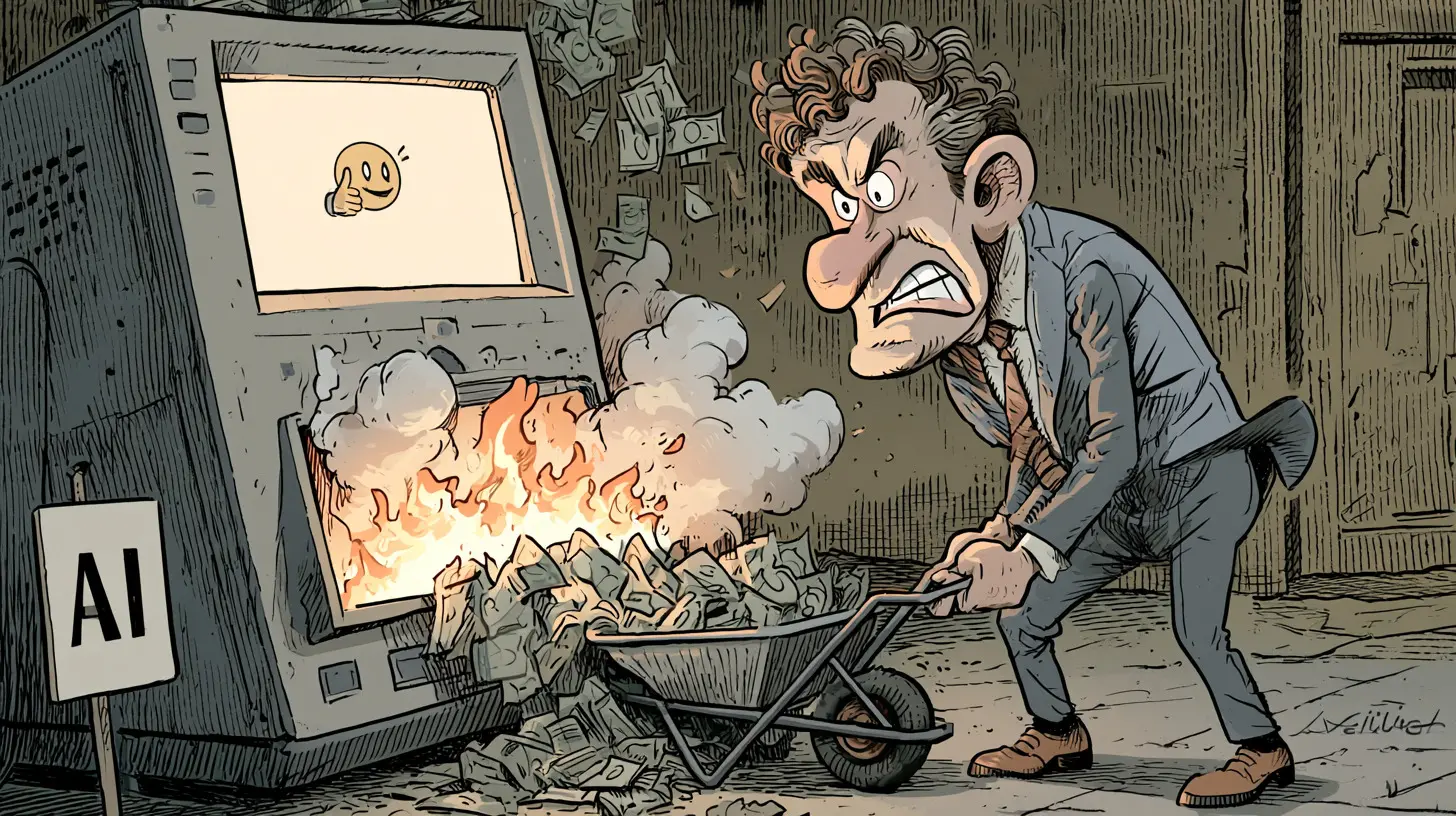
The promise of artificial intelligence to reduce enterprise costs is facing a major reality check. In a startling incident that has sent ripples through the tech industry, an unnamed company burned through approximately $500 million in Claude credits within a single month. The cause? A simple oversight: the company failed to set usage limits for its employees, allowing unrestricted access to Anthropic's AI model. This massive overspend has become a cautionary tale for organizations rushing to adopt AI without proper governance.
The $500 million mistake
According to recent reports, the company's employees used the Claude AI platform with no guardrails in place, leading to an astronomical bill. Claude credits, which are consumed each time the model generates text or processes tasks, accumulated rapidly as workers explored the tool without any budget constraints. While the company remains unnamed, the incident highlights a critical flaw in the rush to integrate AI into daily operations. Many enterprises have adopted a "tokenmaxxing" mindset, encouraging excessive usage of AI credits under the assumption that more AI equals higher productivity. This assumption is now being challenged as costs spiral out of control.
AI cost-saving promises crumble
For years, technology vendors have promoted AI as a way to automate tasks, reduce labor costs, and boost efficiency. However, the reality is proving more complex. Executives from major corporations including Costco, Delta Airlines, and IBM have recently expressed skepticism about AI's return on investment. Even Uber's new COO, Andrew Macdonald, publicly commented that AI-related costs and token usage have not improved workers' productivity as expected. In fact, Uber engineers reportedly exhausted their AI budget for 2026 well ahead of schedule. These statements reflect a growing sentiment that the initial AI frenzy may have been overhyped.
The $500 million incident is not isolated. Other companies are also struggling to keep AI costs under control. Microsoft, which initially encouraged employees to use AI tools like Claude and Copilot, has now started canceling subscriptions and discouraging excessive usage. Just six months after pushing workers across various profiles to "vibe-code" more, Microsoft is reversing course. This shift indicates that even firms betting their future on AI are recognizing the need for fiscal discipline.
Understanding tokenmaxxing and its consequences
The term "tokenmaxxing" describes the behavior of burning through AI credits as quickly as possible. It emerged from a culture where employees are incentivized to use AI for every possible task—from writing emails to generating code—without considering the cost per token. Token pricing varies by model and provider, but enterprise plans can run into thousands of dollars per month for heavy usage. When multiplied across thousands of employees, the bill can become staggering.
In the case of the $500 million overspend, the lack of limits meant that each employee could theoretically consume unlimited tokens. This is analogous to giving every worker a corporate credit card with no spending cap and no oversight. The result is predictable: costs skyrocket. Providers like Anthropic and Google have since moved to usage-based billing models and stricter limits, which has upset many non-enterprise users but is necessary for sustainable business
Provider responses and industry trends
Anthropic, the creator of Claude, has not commented publicly on the incident, but the industry is taking note. Google has been building more cost-efficient models and inference techniques to address the cost crisis. A recent Gartner report predicts that inference costs for generative AI models in 2030 will be only a tenth of what they were in 2025. However, the report also warns that token usage could expand 5 to 30 times current levels, potentially offsetting any cost savings. The combination of cheaper per-token pricing and skyrocketing usage could keep enterprise AI budgets under intense pressure.
Meanwhile, corporations are beginning to abandon the tokenmaxxing approach. Instead of treating AI as a limitless resource, companies are budgeting for specific use cases. For example, AI might be authorized for customer-facing chatbots or code validation, but not for casual experimentation. This pragmatic shift mirrors earlier enterprise adoptions of cloud computing, where unconstrained usage led to bill shocks and subsequent policies to monitor and limit consumption.
The broader pushback against AI costs
The pushback is not limited to enterprises. Consumers are also feeling the pinch as providers tighten free tiers and increase subscription prices. Google, OpenAI, and Anthropic have all adjusted their pricing models to ensure profitability. This has led to frustration among individual users who rely on AI for personal projects.
Even as costs rise, the dependencies on AI continue to grow. Companies are embedding AI into critical workflows, making it harder to pull back. The challenge now is to find a balance between leveraging AI's potential and maintaining financial control. The $500 million incident serves as a stark reminder that without proper governance, the costs of AI can quickly outpace its benefits.
Historical context and lessons learned
This is not the first time a technology has promised cost savings only to create new expense categories. The dot-com boom saw massive investments in internet infrastructure that initially seemed wasteful but eventually yielded long-term value. Similarly, cloud computing faced early resistance due to high variable costs compared to on-premise fixed costs. Over time, enterprises developed cloud cost management practices. The AI industry is now undergoing a similar maturation process.
Corporations are hiring AI cost analysts and implementing usage dashboards. Some are requiring departmental budget approvals before granting access to premium models. These steps are reminiscent of the shift from unmonitored cloud spending to the rise of FinOps—financial operations teams that optimize cloud costs.
The lesson from the $500 million mistake is clear: AI is a powerful tool, but it must be deployed with the same rigor as any other corporate resource. Setting limits, monitoring usage, and aligning AI consumption with business outcomes are essential for sustainable adoption. As one analyst noted, "The AI bubble may not burst, but the dream of unlimited, cheap AI is ending."
Moving forward, we can expect more enterprises to adopt strict AI governance policies. Providers will continue to refine their pricing models to match enterprise needs, likely offering more predictable fixed-price plans rather than pay-per-token. The era of tokenmaxxing is giving way to a new phase of strategic AI investment, where every token must deliver measurable value. The companies that adapt will thrive; those that do not may find themselves facing their own $500 million wake-up call.
Uber's experience of exhausting its AI budget for 2026 well ahead of schedule echoes the broader industry sentiment. The company's COO, Andrew Macdonald, stressed that token usage did not translate to productivity gains. This observation is critical: the correlation between AI usage and employee efficiency is not as strong as vendors claim. Many tasks that are automated by AI still require human oversight, quality checks, and creative input, negating some cost advantages.
Major retailers like Costco have publicly announced a preference for retaining human workforce over AI-driven automation, citing customer service quality and the complexity of real-world interactions. Delta Airlines has echoed similar concerns, especially in safety-critical roles. This does not mean AI is being abandoned, but its role is being recalibrated from a universal replacement tool to a focused assistant for specific, high-value tasks.
The shift in Microsoft's stance is particularly telling. The company, which has invested billions in OpenAI and integrated AI into Office products, is now limiting its own employees' use of Claude. This move suggests a recognition that unrestricted AI access can lead to counterproductive behavior. Microsoft is encouraging employees to use its own Copilot tools, which are more tightly integrated and monitored, rather than third-party models that lack usage controls.
In response to these pressures, AI providers are innovating on cost-efficiency. Google's latest inference techniques claim to reduce token cost by up to 50% for certain workloads. Anthropic has introduced message-level pricing that caps costs for standard tasks, even if token usage varies. These developments indicate that the industry is listening to enterprise demands for predictable pricing.
Yet, the overall trajectory of AI adoption remains upward. Gartner's prediction of lower unit costs paired with higher token volumes suggests that total spending will continue to rise, but in a more controlled manner. Enterprises will need to develop sophisticated cost management strategies, similar to how they handle cloud computing budgets today. This includes rightsizing AI models to tasks—using smaller, cheaper models for simple queries and reserving large frontier models for complex reasoning.
The $500 million incident may be an outlier in magnitude, but it reflects a systemic issue. As more companies deploy AI without guardrails, similar (if smaller) budget overruns will occur. The industry is still learning how to manage this new resource. Ultimately, the AI dream is not ending; it is evolving from a reckless sprint into a disciplined marathon. The winners will be those that balance innovation with fiscal responsibility.
Source: Android Authority News